Reading the Tonal Field Through Solfege Vowels
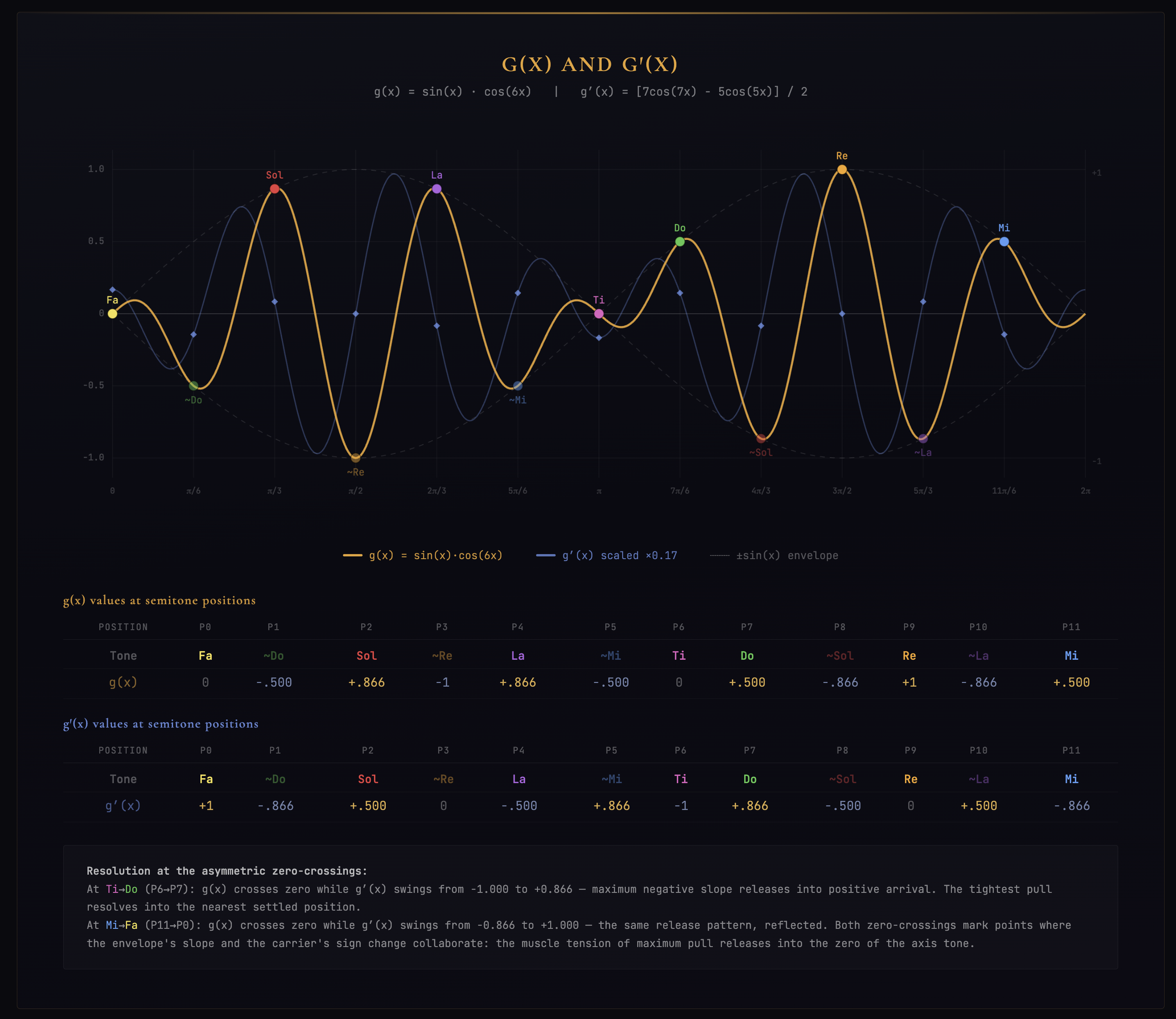
This plot shows two functions. The gold curve, g(x), measures the continuous gradient of tonal stability. The peaks, valleys, & asymmetric zero crossings show where the pentatonic, anti-pentatonic (notated with a ~) & the special axis tones (Fa & Ti) of the diatonic scale can all be found. The diatonic scale contains one tritone — Fa-Ti — and the ear can hear it two ways. The function produces the two complimentary pentatonic sets by calculating the interference pattern between the two possible interpretations of the Ti-Fa tritone's ambiguity.
The blue curve, g'(x), measures how hard each tone pulls toward its neighboring tones. g'(x) describes the rate of change, the slope, the force that drives one tone toward the next.
You don't need to understand the math to feel what these curves describe. In fact, this presentation uses simple vowel exercises that will allow you to embody & sustain any of the tonal states located on this field using your own singing voice.
A note on how to use solfege
Throughout what follows, I'll ask you to sing classic solfege syllables. When you do, drop the first-letter consonants from each solfege label, & just sing the latin vowels. When you sing, the consonants create small interruptions in what would otherwise be constant voiced tones. The tonal content of each syllable is its vowel: the sustained, resonant part that carries pitch and lives in the body. Do is /o/. Re is /e/. Mi is /i/.
Try singing "Do, Re, Mi" with consonants & you'll see how consonants chop the tonal experience into labeled fragments.
Instead, try singing /o/-/e/-/i/ as a continuous stream. Notice how the jaw, tongue, even the larynx tend to rise along with these three pitches. The continuous sonority lets you feel the transitions themselves. Three vowels can be integrated as one path that rises & falls along with pitch.
Solfege is precisely the tool we reach for when we want to explore the relationships of the tonal field. By removing the consonants we can focus more closely on those tonal relationships. As you will see, dropping the consonants from solfege allows us to find somatic patterns exist among the vowels that the presence of the consonants otherwise obscures.
The two half-step resolutions
Sing a sequence of two tones rising via half-step. If you make the first tone an /i/ vowel & the second to /o/, you will effectively produce the feeling of the Ti-Do half step. Remember not to articulate the consonants — just let the vowel change follow along with the change in pitch.
Rock back & forth between the two pitches of the half step, slurring back to the vowel /i/ as you move toward the lower pitch, & gradually open back up to /o/ as you rise back up the half step.
Notice what happens. The /i/ is closed. The tongue is high and forward, the throat is narrow, the vocal tract is constricted. Then as the pitch rises one half step to Do, the vowel opens to /o/. The jaw relaxes. The tongue drops. The lips round softly. Everything releases.
Now look at the plot. At Ti, g'(x) = −1. Maximum pull. At Do, g'(x) = +0.866. Strong arrival. The function's steepest descent resolves into one of its most positive positions. What your body just did — the tension of /i/ releasing into the openness of /o/ — is what the derivative describes.
Now sing Mi up to Fa: /i/ to /a/. Same half-step interval. Same closed vowel opening into a released one. But the release feels different. The /a/ is wider than the /o/. The jaw drops further. The opening is more complete.
The plot shows why. At Mi, g'(x) = −0.866. Strong pull. At Fa, g'(x) = +1. Maximum arrival. The swing is the same total magnitude as Ti→Do, but Fa absorbs more completely than Do does. The /a/ vowel — the most open, most relaxed vowel in the system — sits at the point of maximum positive derivative. The body opens fully precisely where the field opens fully.
The still center
Now sing Re on /e/. Just hold it. Notice how little effort it takes. The tongue is mid-height, the jaw is neutral, nothing is reaching or pulling. It's the easiest vowel to sustain.
On the plot, Re sits at g'(x) = 0. Zero pull. The field is balanced here between its major & minor bifurcations. The vowel and the derivative agree: nothing is driving this tone anywhere. It is the balance point.
This system shows Re as the center of tonal symmetry, which is just a fact- Re is the only tone equidistant from both diatonic half steps. Many interesting findings follow from recognizing Re's symmetrical centrality in the diatonic pattern, but it doesn't mean that Re has the same properties of resolution as Do. Do's strong modal resolution is described by the rate of change: g'(x).
The Sol region
Sing continuously through Fa, Sol, La in sequence: /a/-/o/-/a/. Your mouth barely changes shape between these three tones. The jaw stays open. The tongue stays low. The only change is a slight lip rounding on Sol's /o/, then back to open /a/ on La.
But something shifts. Despite the vocal continuity, Sol carries a tension its neighbors don't. Fa & La feel more locally settled (resolved) compared to Sol.
The plot shows the mechanism. Fa and La sit on opposite sides of the derivative's zero-crossing: Fa at g'(x) = +1, La at g'(x) = −0.5. Sol sits between them at g'(x) = +0.5 — still positive, still pushing forward, not yet turned. It has the same positional weight as La (both are +0.866 on g(x)), but their respective momentums are reversed. The lip rounding on /o/ is the single physical gesture that marks this: same open resonance as /a/, but shaped. Directed. The body registers Sol's unresolved momentum with the smallest possible articulatory change.
The Smooth Modulation Experiment
The exercises discussed so far demonstrate what it is like to move within a stable instance of the tonal field (a single key). The following exercises will allow you to use your voice to experience how the field rotates to other stable orientations (modulation to other keys).
As before, sing the rising half step slide starting on /i/ & smoothy arriving at /o/ to generate the feeling of Ti -> Do. Feel the resolution. The body opens, the tone arrives, the field settles.
Now start singing on /i/ again, but this time, as you slide up, form the half step higher pitch on the /a/ vowel instead. Notice that these are the same two pitches as before, but the expectation is subtlty (yet no less than completely) different. You still feel the similar resolution, but look around & you will notice the tonal ground has rotated — the pitch you landed on is now functioning as Fa of a new key whose Do sits a perfect fourth below the original Do. Continuing from the /i/-/a/ landscape means continuing from a different place on the map, specifically the other diatonic half step: Mi-Fa.
If you now start from /a/ on the Fa pitch, you can feel how your ear is not only still primed to drop back into /i/ (Mi), but to continue down a whole step to /e/ (Re), & one more whole step down resolves to a new Do (on a pitch a perfect fourth lower than the Do established in the first orientation. This slightest possible change in vowel, resulted in a smooth pivot into to one of the nearest alternate keys. The expectation field maintains its internal relationships, but has undergone a rotation.
If you want to rotate the field back: just sing your way back to the /i/ vowel, but follow it up a half step with /o/ instead of /a/, this will effectively change the role of that axis semitone back to Ti-Do, effectively rotating your expectations back to the previous key.
The flip
There's one more experiment, and it reveals the most extreme thing the field can do.
Start on Ti again: /i/. Now, instead of going up, keep the /i/ vowel as you slide down one half step. Look at the g(x) plot & you'll see to the region one half step below Ti is labeled ~Mi : /i/→/i/. The vowel doesn't change.
~Mi represents the tone that would be Mi if the field were flipped 180 degrees- if the other interpretation of the Fa/Ti tritone were actually in effect, & every tone in the system trades places with its complement, the axis itself acting as the hinge.
Holding onto the /i/ as you sink a half step from Ti into ~Mi instantly transports you to the farthest possible key; a tritone away.
From this new Mi, step back up one half step — but let the vowel change: /i/→/a/. You'll land on the same pitch you started from. But it doesn't feel like a return. It feels like an arrival — because in the flipped field, this is Mi resolving up to Fa. The /a/ vowel confirms it. Your mouth opens into the resolution, and the pitch that was Ti a moment ago is now Fa. The axis tone has been recast. The body recognizes the new role immediately because /i/→/a/ is how Mi→Fa has always felt.
Now try the alternative. From that same ~Mi-becoming-Mi, step back up the half step but stay on /i/: sing /i/→/i/. Don't let the vowel open. You'll feel something completely different — the field resisting, then snapping back. The /i/ vowel refuses to confirm the flip. It holds the original Ti in place. The ear has to do the work of un-flipping the entire field, restabilizing every tone back into its original role. That's not a resolution. That's a reconstruction. And it's noticeably harder (at least at first).
The difference between these two returns — /i/→/a/ versus /i/→/i/ — is the difference between moving with the field and moving against it. In /i/→/a/, the ear has already committed to the new orientation, the vowel confirms it, and the body lands without effort. In /i/→/i/, the ear has to reject the orientation it just adopted and rebuild the original one from scratch. Same pitch. Same interval. Same starting point. Completely different cognitive work.
This is what makes the flip the most vivid demonstration of the field's cognitive nature. Nothing acoustic has changed between the two returns. The frequencies are identical. The interval is identical. The only difference is whether the vowel lets the flipped field stand or forces it to flip back. And that difference — which you feel as ease versus effort, as arrival versus reconstruction — lives entirely in the ear's model of where it is on the tonal surface.
You can practice this in thirty seconds. Ti, drop to ~Mi, come back as /i/→/a/: easy, the field stays flipped. Ti, drop to ~Mi, come back as /i/→/i/: hard, the field flips back. Repeat until your ear begins to anticipate both outcomes before you sing them. Once it does, you are hearing the field directly — not as theory, not as math, but as the structure your voice navigates every time it moves through tonal space.
After a few repetitions of these exercises, your ear begins to anticipate the rotation before you sing it. You'll begin to know whether the field is about to resolve internally or pivot to a new key before the second tone sounds. That anticipation is not coming from acoustic ratios, from your muscles or your vocal tract — they're all doing the same thing in both cases. It's coming from your ear's model of the tonal field. The expectation is purely cognitive. The body is the control. The ear is the variable.
That is what the generating function describes: the invariant structure of tonal expectation.
The state of /i/
Notice the symmetry of where Ti sits. From /i/, two natural releases are available without any field rotation at all. Upward a half step to Do: /i/→/o/. Downward a whole step to La: /i/→/a/. Both are openings. Both release the constriction of /i/ into a relaxed vowel. One resolves upward into the major side. The other falls downward into the minor side. Both are easy. Both are resolution. The derivative confirms this — Do sits at g'(x) = +0.866, La at g'(x) = −0.500. Both are arrivals, one stronger than the other, in opposite directions.
And then there is the hard path. Drag /i/ down a half step chromatically to ~Mi: /i/→/i/. This is not a resolution. It is a transit. The cognitive effort required to pull the field across that half step is palpable — and if you let the field flip, the effort required to drag it back up is exactly equal. The tritone flip is symmetric. The same work to cross it in either direction. The /i/ vowel holds its shape through the entire transit, which is why you can feel the cognitive weight so precisely — there is no somatic change to absorb or mask it.
But here is what the trained ear discovers. Once the flip happens — once ~Mi becomes Mi and the entire field reverses polarity — the landscape around you has reorganized. The /a/ that was La below you is now Fa above you. The /e/ that was Re above you now lies below. The same vowels, the same intervals, the same resonances in the vocal tract — but every one of them has traded direction. What was descent is now ascent. What was below is now above. The body hasn't moved. The field has turned inside out.
And all of this is available simultaneously from /i/.
That is what the state of /i/ actually is. It is not merely a point of tension awaiting resolution. It is the point of maximum potential in the field — the position from which every path is available. Upward to /o/: major resolution. Downward to /a/: minor resolution. Chromatic drag to the flip: total field reversal, after which /a/ and /e/ have exchanged altitudes and every resolution points in the opposite direction.
A trained singer, sustaining /i/, can feel all of these potentials at once. Not sequentially. Simultaneously. The upward pull toward Do, the downward fall toward La, the chromatic tension of the tritone flip, and the entire reoriented landscape waiting on the other side — all present, all felt, before a single one of them is chosen. That is what audiation means at the level of the body. The voice is still. The vowel is fixed. The ear holds the entire field in suspension, every path weighted, every resolution anticipated. The tone hasn't moved yet, and the music is already happening.
It took me twenty years to draw this map of the tonal field. I hope that sharing it, along with these simple exercises, will let you experience what it is to navigate the field yourself — in as little as twenty minutes.
Explore the plot with your own solfege exercises & above all, have fun.