Day 17 : Over the Hill (& Far Away)
Day 17 : Over the Hill (& Far Away)
I put the parenthesis so you’d know & not just think it was a mistake.
Crouching down on the kitchen floor I pet Oreo who, having just eaten, is sprawled out across the cool times. As the coffee brews, I get up & open the front door. Still pretty dark outside. Oreo comes to the door & I wait to see if he wants to go out. He takes a while to decide that he does not. I close the door, remove the decanter & let the coffee drip directly into my cup.
I already have ruled out the Vose today. I wanted to go back to the Casio to take advantage of its uniform key action. The Vose action is really poorly regulated. I’ve tinkered with regulating its poorest keys, & with some success, but haven’t yet mastered that art.
So I sit down at the Casio.
Practice begins.
I check in with my feet. I look under the Casio for the sustain pedal & remember that a day earlier I had run across another electronic foot pedal that I had lying around. It’s actually the slightly nicer one that came with the Casio. I misplaced it at some point & bought a spare online which I have been using as the Casio’s sustain. I got the extra pedal & plugged it into the only other open jack on the left side of its back panel. The pedal is now the Casio’s left foot una-corda control. It’s worth noting that the instrument comes out of the box with these two jacks, but only one foot pedal. A piano with only one pedal now seems like an incomplete instrument to me. A week ago my opinion would have been different.
Wearing socks I kick the pedals around under the Casio. I take a moment to appreciate the difference here from the Vose. On the Vose the pedals are fixed to the center. My feet had the luxury of centering via conformity. In the Casio’s digital domain anything goes. You want your pedals right, left, wide narrow. The responsibility of placing them & not kicking them out of position while playing is on you.
As I place the pedals in different positions using my feet I start to realize the way I’m sitting on the Casio’s fully adjustable bench (the Casio didn’t even come with a stand, let alone a bench), anyway the knee/ankle placement was crazy. Why would anyone sit like this at this keyboard? Again this now obvious problem stemmed from the placement of the bench. It was placed too close & so it was jamming me up a bit legwise. So I moved it way back.
Boom, feet centered with ankles slightly in front of the knees. Pedals spaced shoulder width & centered. Sides of each foot press slightly into the floor as I lean forward. Grounding the body weight through the sides of the feet blocks postural support shifts from effecting the pedals, which can now by controlled using the fine motor control of the toes.
The Casio’s pedals are two cheap plastic squares. Just a simple hinge & spring- two normally open circuits allowing for momentary electrical contact whenever I send a pulse down from my head to my toes. I practice holding the fine motor muscle tension in my feet. I try to feel the pad of each toe deform against the surface of the plastic. I realize 4 of 5 toes are actually above the top of the pedals. The outside pinky toe of each foot, not being long enough to reach falls off & joins the rest of the foot in pressing into the carpeted ground.
I think of fretboard exercises & try to flex individual toes against the pedal surface. I don’t feel that I can individuate exactly, but there is definitely some sensation of muscle grouping that I suspect from experience might eventually untangle the more I come back here. Actually revisiting this exercise right now, as I sit at the computer with shoes on & type, I can definitely isolate & control flexing just the big toes from the rest. Even more importantly I can clearly separate flexion from extension. I realize how much I am probably over using the foot extensors & practice some flexion only pulse holds - allowing the extensors to merely detect the pedals springiness via a light oppositional force.
The two pedals have a different grip pattern on the surface. Dots on the left, lines on the right. But the springiness feels pretty uniform as does each pedals height. Essentially my feet feel somewhat ideally balanced & wired in to these two cheap plastic pedals. I clack out morse code style patterns with single toe pulses, then double toe pulses. I practice soft slow uniform pulses.
I check in with the breath & even though it’s dark in the studio remember to close my eyes. I relax my shoulders. They fall backwards as I lean forward slightly. Arms to my sides, hands lightly grip the sides of the bench. I silently audiate english sentences & tap the inflected speech cadence with the pedals. I make question & answer rhythms like: uu’uu? uu’u? uuu’? : have you GOT it yet? is it WORking? is this thing ON?
u’u : i THINK so…
I place my hands over the key surface directly in front of me. My arms rotate in & silently return home. I don’t want to turn on any lights just yet. I think about the general open-endedness of this process. How much I know still mostly points to how much I still don’t know. & how that is genuinely one of the funnest parts. I switch to holding both the una corda & sustain circuits lightly but firmly closed, the feeling is similar to how I keep my eyelids down. I rock a bit to test that this setting has latched.
I find that my hands have silently formed the heart shaped box at the center of home. With the lights out. I forgive myself for every bad thing I can recognize that I have done. Not forever, but just in this moment, I experience a specific form of universal forgiveness.
At that moment my right pinky accidentally loses an arrow. Sound shoots up over the noise floor of the headphones. Bright magenta fading away: Tiiiiiiiiiiiiiiiii. Almost reflexively the Left pinky send up its flare in response: Magenta blooms a lower deeper sounding Tiiiiiiiiii in the headphones.
I think about my theoretical documentation work. My “Model of Tonal Cognition”. Other nascent monetization schemes. But goddamnit if it don’t work. Left Ring sends up a single bright green baritone Dooooooo. Sustain is fixed down so each pitch flares like a little individual firework. As the low Do decays off into the distance, it’s color fading with it, my right pinky extends slightly to sending up the octave Do.
As I make up a little dance routine using octave Ti’s & Do’s, I wake up the other fingers. I don’t ask them to play anything yet. Just to watch the left ring & two pinkies perform this warm up.
So I’ve got this half step sounding over & over. & I’m not just hitting it in some static rhythm. I am making language embedded in the meter, & since I’m not really using more than a half-step of tonality this is basically recitative - or rapping. I notice that I have defaulted to using the Ti side of the half step for my alerts, & the Do side for my resolves. I question this.
We haven’t heard any other information today. So why is this Ti/Do? Could it not be Mi/Fa? I try to force this through silent audiation & find that it doesn’t feel like I have a current clear path that does that from here. Why? Well. Even though I haven’t sounded them yet, I know that I have the Mi/Fa half step locked into this hand shaped. What happens next feels coincidental, but it happened just as I was thinking about how the Mi/Fa was silently asserting itself into my experience from the hand shape- the right index accidentally connects & lets loose a very soft Faaaaaaaa. The auditory system floods with whatever chemicals produce confirmation.
I celebrate by waking everyone up. Turning on every light in the house. Rolling the notes up & down, the same way I kind of whip up the bedsheets when you are trying to make the bed, trimming the wash of synthesized overtones with both feet. The left foot’s una corda behaves like a tight volume control, & works like a zoom lens on the spiral of tonal sounds.
I realize that I am using a brisk rolling 16th note rhythm pattern that has default biased the rolling tonal field toward C_Do mode. Keeping time & this same emphasis figure out how to move the bias to La. The feeling is like when you are in the warm ocean & all of a sudden there is a very cold current of water rushing past your legs. I go back to emphasizing Do with the same pattern. It’s like controlling temperature in the shower- a nice one, where it only takes a second or two to feel the water change. This makes it easy to set the dial right where you want it.
I think about the cognition model. Shouldn’t i be reaching for ~Re or something more ambitious like that? Instead I’m here kicking around in the C major kiddie pool. I counter that thought with the recognition that intra-series modal shifting is equally as important a thing to practice through sustained experience. On or any that uses this style of keyboard is its tonal interface, intraseries modal shifting is can be most efficiently done using the white key pattern. I shift my pattern around & listen as each (now deeply anticipated) modal color comes up.
I give modal shifting its final test. I ask it to speak for me. Can it speak in rhythm. It can. What does it say? It reminds me about the forgiveness. It says that it really means it. & that i run away from things like that too quickly. I think about the ~Re. The sound that would insist this is all backwards. The thing that would blow it all up. The axiom states that any key could be ~Re, but where is it from here? From the all white key group? Of course. There it is. Right in the center of the black key pattern. The silent nuclear Mesopotamia. If I want it, the closest move would be to use the middle finger of the right hand at home. Like flicking on the light bulb in the center of the attic, where my parents used to keep all my old stuff.
As the 16th notes continue to roll around, holding steady modes & then shifting, making balanced numbers of bars, before reaching for ~Re I try to audiate it. I can’t. I know kind of what it will feel like. The total destabilization. But I can’t audiate it clearly & definitively as I have been doing over & over with these intraseries modal shifts.
I go for it. I abandon the white keys & flood the headphone space with two middle fingers. Touching off fireworks from every octave. I sit up & back from the keyboard as my arms widen. Watching the white ocean world explode from space.
Then I bring it back. I find that my audiate memory of the C_Do stayed slightly ahead of my hands execution which brings the sound back to the headphones. Confirmation floods back in. & I can still remember the sound & precise feeling of the ~Re, while still hearing C_Do (~Re’s Ti/Fa axis summed with all five of its anti pentatonic tones). Alternating a few bars of C_Do modal confirmation sounds against a strings of just ~Re octave tones makes for some cool & surprising riffing. ~Re bring tension like a super charged dominant against the C_Do mode. & Then returning to C_Do afterward lowers the excitement back down every time. So I speak through this framework for a while. It felt like such a fresh sound & I felt so in control of it.
I thought about Remi. How I’d be sure to show him this (if/when he’s interested). In the right and I played the melody to Mary Had a Little Lamb in C_Do while in the left i alternated the domisol triad with ~Re in place of the dominant soltire. The effect was a kind of extremely bizarre coherence.
I think about the cognition model. I drop all C_Do pentatonics. As they fade out in sustain I keep launching the white Ti/Fa axis with the only visibly symmetrical Re/~Re axis. The sound is of course familiar. The fully diminished 7th chord- but now looking & sounding like never before. The structure of its look & sound so clearly mapped out across my hands & in my headphones. The white D_Re low & square between the white Ti/Fa. The black ~Re sticking up at the center of its black hill. I roll this chord rhythmically across the expanse of registers. Audiating the coin as it flips & flips & flips.
At that moment Oreo hops up on the bench to my right. Silently placing a demand for attention. Fair enough. I keep the chord rolling in the left hand, & relieve the right of duty to go scratch Oreo. After about 2 minutes of solo left hand work, Oreo decided to move & resettles to my left. Without missing a beat, my right hand takes the baton of keeping the dim7 chord alive & my left hand scratches Oreo.
Doing this leads me to I realize that I can either play the keys with my hands, or the sounds with my head. Once the sound is clear, there is less & less need to think about the hands. This extra bandwidth can then be redirected toward rhythm, dynamics: language.
Practice ends.
Additional note:
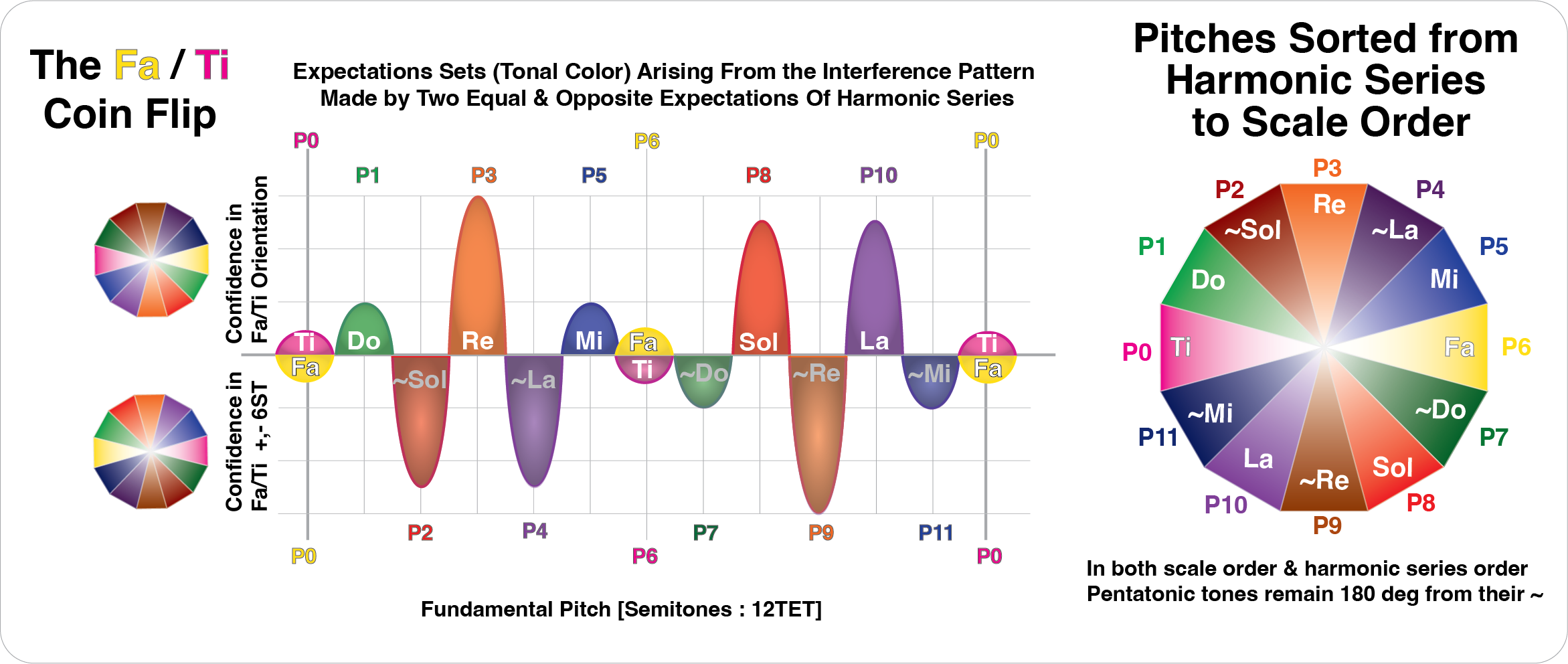
The night before this morning’s practice, I made this revision to how I think the interference might actually be functioning. In earlier versions, Re/~Re was being expressed as contributing least information to tonal stability, Ti/Fa contributing most. But Ti/Fa, once established is defined by its directional ambiguity. Re/~Re therefore in theory should be the maximum indicator of any given Ti/Fa. Today's practice was in part influenced by that being on my mind. I wanted to see whether isolating ~Re functioned this way in practice. Todays practice provided a demonstrable from of confirmation. A fun, easy, reproducible way to show that this is indeed how the Re/~Re axis functions when the language is in practice. (See attached chart image: Interference Pattern.png)
Playing only the four pitches that create the dim7, arpeggiating them up & down for a long time, felt very much like what the model predicts it should. After a while I couldn't tell which tritone was Ti/Fa & which tritone was Re/~Re anymore. I could reaudiate the sound of the white pentatonic (re-establish the old key center). & i could audiate the dim7 (detonating it). But to truly feel it re form confidence in the 90deg rotation (making D, Ab the Ti/Fa), I would need to touch or to audiate one of the remaining 4 black key pitches. I thought about doing this before ending practice, but I wanted to document what I had first.
& I’ll just note in closing, that the dim7 has 4 equal orientations (2 for each tritone axis). There are 4 black keys left to audiate. Like a hallway with 4 doors & perhaps 4 corresponding keys. I suspect I can complete this arc during tomorrow's practice.