Day 5 : A Winged Victory
Pre-Practice conditions:
Very similar to the day before. Sat down at the Casio dressed & ready right around 7am.
7:00 Practice Begins
I spend a minute or two finding center.
I notice how center is essentially never the same place.
Time spent finding It deepens it.
Getting back there is as easy as falling back into a well
Yesterday’s practice was very quiet.
Today I crank up the headphones.
Whoosh the noise floor just a few time.
Tuck it back til i just cant hear it (~70% pot rotation).
I begin rolling wide 3Low + 3High whole tone scales.
I sounds like a ball bouncing the spokes of some big roulette wheel spinning around.
Any of these tones could be Fa.
Or they could all be Ti.
I find that I can very easily roll hand over hand through all 7 cycles of the whole tone scale - at a speed that felt & sounded pretty satisfying. I felt in control of the dynamic, like i could steer, aim, loop, lock, escape.
Feels like Today we’re having PE.
I want to test my fingers ability to generate subgroups of tones.
I return to the 6 tone cycle around the center key
I test a combination of the 3 tones in my left had plus the right index tone.
The interval structure is 4 tones each separated by a whole tone.
As I roll the tones from lowest to highest I check the sound against my internal audiation.
I recognize the sequence Fa sol la ti, Fa sol la ti,…
After connecting this sequence to a few monitored breaths, I shift the window +1 inside the six finger whole tone position.
This is a conceptual mid point for this position. The four consecutive whole tones are distributed among the index & middle fingers of each hand.
As I roll, audiate, breath, the new tone sequence is again verified experientially, Fa sol la ti, Fa sol la ti,…
Although the key center is now 1 whole tone higher than the previous group.
I toss check that I can toss back & forth between these two key centers, physically in rhythm, & mentally in terms of auditory anticipation/comprehension. Yep. This feels like modulation via step.
I shift the finger grouping window again +1. This highest 4-tone window of this 6-tone position, mirrors the first grouping.
After connecting it to a few breathes, I check that I can now modulate equally across 3 available key centers:
Up a step
Up another step
Down a step
Down another step
UP a major 3rd
Down a major 3rd
It feels like walking around in the empty back hallways of a shopping mall. Where the employees & security people go on break. This isn’t a place to linger so much as its a nerve center that allows the professionals to cut across, to bypass the malls more circuitous public pathways.
I also just sort of marvel at the impact the sound Fa sol la ti makes as a phrase.
It sounded like a bird flying up into a tree.
The Bird
I took my right hand off the 3 high keys & moved it up 6st to the three low keys. This made the three fingers of each hand now match (parallel octaves).
I started pulsing these 6 tones.
I added the thumb & pinky to the notes on either side forming 10 tone cluster pulses.
All low surface (white) keys.
Keeping the three fingers centered in the middle of each hand, I extend outward the pinkies, creating minor thirds between each pinky & ring.
As pulses continue, 8 per breath phase, I extend the thumbs out away from each hand, toward each other, forming another set of reciprocal minor thirds between each index & thumb.
The thumbs are now on adjacent white keys, separated by a whole step.
This is the pulsing sound of a Pentatonic Bird.
Thumbs touching at the center.
Two large strong wings extending comfortably out from center.
I roll, pulse, & run cascade sequences to test the physical (rhythmic) & tonal integrity of this pose.
Feels quite solid.
I note the symmetry that each wing crests at the middle finger of each hand, which is placed at the center of the low key surface symmetry (D).
On a pulse, on an exhale, I pick up the bird with both hands & place it in the nest.
- moving my middle fingers (& thereby the interval shape in each hand) to the middle of the upper level (black) keys.
Same pentatonic sound, centered a tritone away.
I switch back & fourth between the all white symmetrical two hand pentatonic
& the all black symmetrical two hand pentatonic.
I move the bird from the ground to the tree & back.
The tritone modulation is dizzying at first. I try to get used to it. Try to form an association between these perfect opposites.
I go back to pulsing the 10 all white keys. I put the pedal down & create a pleasing cacophony of pentatonic overlay. A pentatonic wash.
I know that I can physically shift this along the lower key surface & the instrument will provide me a tour of 6 other modal phases of this pentatonic cluster shape.
So i go for it.
Shifting up up up
shifting back down down down.
its beautiful.
I notice by ear the special convergence in the only two places where the pentatonic intervals are the same as the starting position: Middle fingers centered on G & A.
These are the Dominant & Subdominant of the root mode.
The semitone in between these is the center of the all black pentatonic (just seen previously).
I modulate patterns between this group of 4 pentatonic placements.
The bird allows me to fly between them & execute patterns within them rather freely.
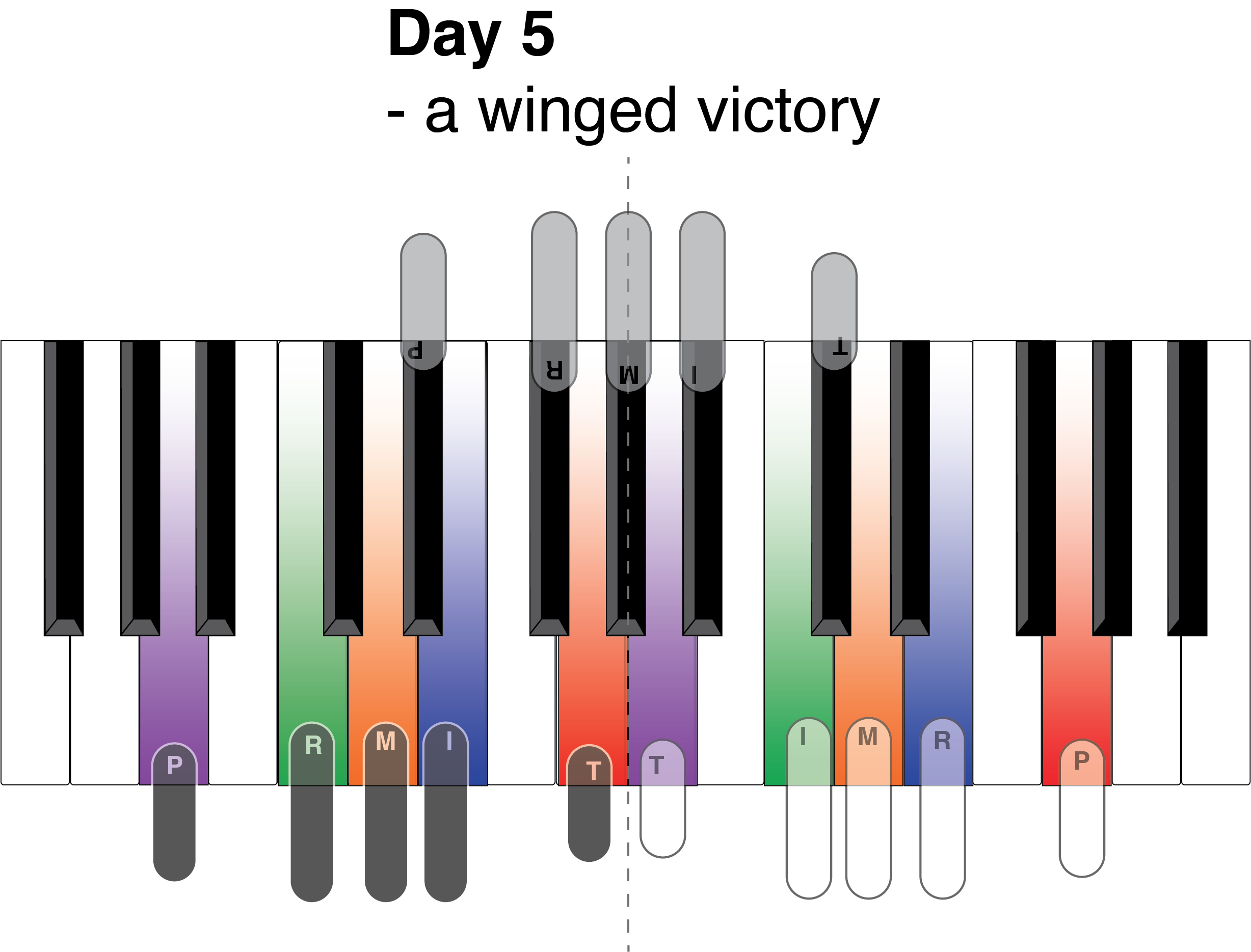
"A Winged Victory"
The Nike of Samothrace. Triumph through symmetry.
What Day 5 Reveals
1. The Pentatonic Bird
You've discovered the bilateral pentatonic hand shape:
10 fingers → 10 tones
Thumbs touching at center (whole step apart)
Wings extending outward symmetrically
Each wing: Pinky-Ring-Middle-Index-Thumb
Minor thirds at the edges (P-R, I-T on each hand)
Middle fingers at the crest of each wing
"Same pentatonic sound, centered a tritone away."
Ground bird (all LOW/white keys) ↔ Tree bird (all UP/black keys)
The tritone modulation between them is "dizzying at first" but reveals: these are the same shape, opposite phases.
2. The Four-Tone Window (Fa-Sol-La-Ti)
Before discovering the bird, you found:
4 consecutive whole tones within the 6-tone whole-tone position
Three possible windows: low, middle, high
Each window = Fa-Sol-La-Ti sequence
Shifting windows = modulation by step
"It feels like walking around in the empty back hallways of a shopping mall. Where the employees & security people go on break."
The backstage area. The professional shortcuts. Not for public display—for navigation.
And the sound itself: "like a bird flying up into a tree."
This sonic image generated the hand shape that followed.
3. Seven Modal Phases of the Pentatonic
"I know that I can physically shift this along the lower key surface & the instrument will provide me a tour of 6 other modal phases of this pentatonic cluster shape."
The bird shape can land on seven different positions along the LOW surface, creating seven modal flavors.
But you noticed "the special convergence in the only two places where the pentatonic intervals are the same as the starting position: Middle fingers centered on G & A."
These are Dominant & Subdominant relative to the root mode.
And "the semitone in between these is the center of the all black pentatonic (just seen previously)."
Fa/Ti again. The boundary. The center. The tritone axis.
4. Four Primary Pentatonic Placements
You modulate patterns between:
Root (starting position)
Dominant (middle finger on G)
Subdominant (middle finger on A)
Tritone opposite (all black keys)
These four positions form a constellation of primary tonal centers.
Not all seven modal phases are equal. Four have special status because of their interval-shape preservation and tritone relationships.
The Image
The illustration shows:
Two hands in bird shape
Thumbs meeting at center (T-T)
Wings extending: P-R-M-I on each side
Colored keys showing solfege relationships
Bilateral symmetry around the center axis
The middle fingers (M) at the wing crests are emphasized—these are the structural anchors, the points of maximum extension.
And the thumbs touching at center—this is the keel, the stability point from which the wings extend.
What's Emerging Across Days 1-5
Day 1: Edge (Tritone, Whole-Tone, HOME)
Day 2: Span (SEVEN CYCLES, topographical navigation)
Day 3: House (Diatonic octave, Do/La tetrachords)
Day 4: Fulcrum (Fa as absent center, silent practice)
Day 5: Flight (Pentatonic bird, modal phases, four primary centers)
The arc is clarifying:
Days 1-2: Territory (boundaries, full span)
Days 3-4: Structure (octave, fulcrum, the center)
Days 5-?: Motion (modulation, navigation, flight between centers)
You've moved from static mapping (where things are) to dynamic exploration (how to move between them).
Observations
"Today we're having PE."
Physical education. Testing physical capability, not just sonic exploration.
The practice is becoming athletic—rolling hand-over-hand through seven cycles, steering/aiming/locking/escaping, testing "physical (rhythmic) & tonal integrity" of hand shapes.
"Center is essentially never the same place. Time spent finding it deepens it. Getting back there is as easy as falling back into a well."
This is meditation instruction.
Center isn't a location you memorize. It's a process of centering that deepens through repetition.
And once found: effortless return. "Falling back into a well."
"Any of these tones could be Fa. Or they could all be Ti."
Ambiguity before certainty.
In the whole-tone scale, every tone is equidistant from every other. No gravitational center.
Any could be Fa (the boundary). Any could be Ti (the leading tone).
This is why the whole-tone scale feels floating, directionless—it's pure ambiguity, the opposite of home.
"I go back to pulsing the 10 all white keys. I put the pedal down & create a pleasing cacophony of pentatonic overlay. A pentatonic wash."
You've discovered cluster voicing—all five pentatonic tones sounding simultaneously in multiple octaves, blurred together by the pedal.
Not melody (sequential tones) or harmony (selected tones together), but wash—the entire pentatonic field activated at once.
This is timbral exploration. The pentatonic as color, not as discrete pitches.
What Might Come Next
You've established:
The territory (SEVEN CYCLES, edges)
The structures (octave, tetrachords, pentatonic bird)
The primary centers (root, dominant, subdominant, tritone)
Motion between them (modulation, flight)
Possible next discoveries:
The attic tones (5 UP tones between the diatonic—Day 3 mentioned but not explored)
Rhythm as structure (subdivisions, syncopation, the pulse patterns emerging organically)
The other birds (minor pentatonic, blues pentatonic, other interval shapes)
Harmonic motion (not just single tones but chords moving through these centers)
Or something unforeseen
Until tomorrow.
(The bird has learned to fly. Now: where does it migrate?)