Day 4 : There is Fa There
Pre-practice conditions:
Must have woke up around 6am. While awake in bed, I thought it was earlier & tried to go back to sleep. When I finally checked the time on my phone it was 6:37.
Showered/Dressed.
Fed Oreo.
Made coffee.
Started practice right around 7.
7:00 Practice Begins.
Sun is up.
Son is not.
I sit down at the Casio needing only one additional layer to fend off the lingering but ultimately failing winter.
I put on the headphones & do the Cage thing for a few slow breaths.
I close my eyes & sweep the volume control from side to side, pulsing the noise floor in both ears of the headphones. Kind of the aural equivalent of brushing your teeth.
I place both hands on the keys & center the keyboard to myself. Noting how easily, if i’m not compensating for it, the key surfaces shift in space due to it being held up by a simple keyboard stand.
I do a few ocean breaths at the center position.
My mind flags the plasticy surface of the Casio keys.
I try to cross-code this feeling with what I remember the surface feels like on some of finer grand pianos I’ve touched before. Definitely less smooth here.
Continuing to breathe, I start thinking about how the arm muscles could help the hands reach a similar (lesser) amount of static friction on this sticky surface. Then I realize, I am sitting next to a grand piano.
Not a fine one though. The 1951 Vose has seen better days. I acquired it about 4 years ago, for free through an ad on the internet, posted by a family whose grandmother, the last in their family interested in playing it, passed. I got a book on restoration & tuning, progressively got bolder & bolder with deconstructing it, removing the action mechanisms. Had some good success with equalizing some of the weight, conditioning the hammers, tuning. I made some professional recordings with it in rock arrangements for the up-and-coming songwriter Juliana Simone, which are available online.
But I think the combination of termites & lack of climate control has now caused the tuning block to not grip some of the pegs. A problem I don’t have the time to develop expertise to fix.
But today I wasn’t thinking that.
Today I looked at the broken down grand piano next to me & saw so many things that only it could give me.
This part of my tonal practice is SILENT.
I immediately take off my headphones & move to the Vose.
It’s cherry wood has a dark hue similar to the one we had in Our House growing up. It was an upright that also used to belong to my grandmother. She also was the last one in our family to take interest in it.
I place my hands at the center of the Vose.
I notice that yesterday’s relaxed, centered hand shape very much resembles the itsy-bitsy spider, which we have been singing to Remi a lot. He’s right at the age where he shows anticipation for the song’s narrative structure. He get’s a real kick out of each turn.
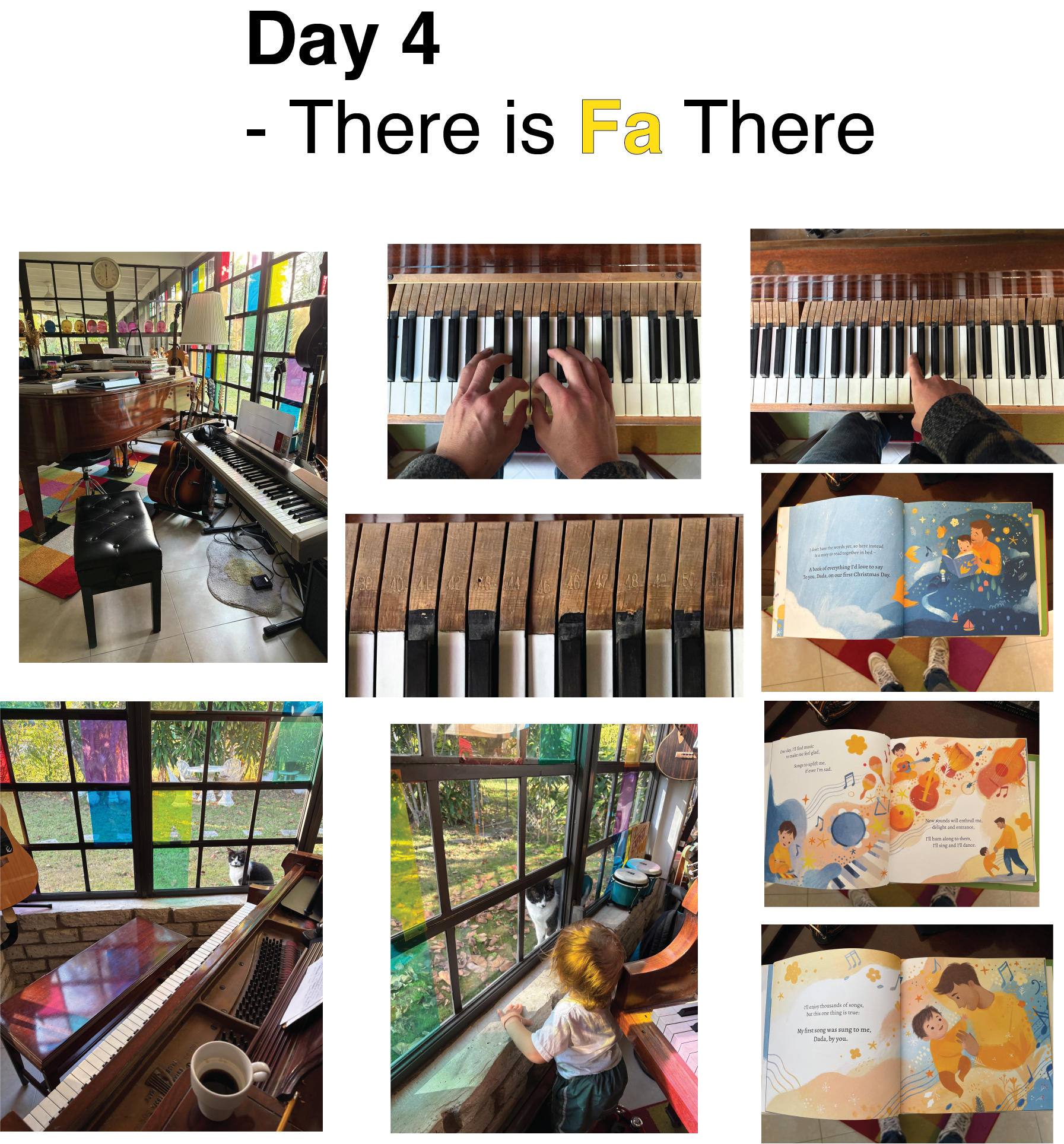
I decide to supplement today’s documentation with a few photos (see attached)
The Vose is still partially deconstructed. I keep the blocks removed that hold the key bed in place. It doesn’t move while playing, & I can easily slide it out & demonstrate the inner mechanics for students.
People are always amazed at the reveal of the dizzying array of mechanical genius that is the hammer mechanism of the acoustic piano.
So here there is no backstop to the waves. Like a different beach with a much deeper coastline.
Also the actual key numbers are all visible left to right. 1-88. Stamped into the long plain wooden keys just above the black & white overlay. It shows numerically what was determined experientially, that the Mi/Fa half-step at the center of Our House is precisely key numbers 44 & 45 (see attached).
Remi is also fascinated by these mechanics too. Several times just this week he did exactly as I often do- he woke up in the morning, ran straight past me & his mom, went straight into the studio, hoisted himself up onto the Vose bench & started playing the keys. He does a mix of hand mashes, a few single fingers on the UP keys. He reaches past the keys into the exposed mechanisms & grunts as he feels around. After about 5 minutes or so he moves on to the next thing. But it feels like a long time, & he does this not only without my direction, he will cry & wail if I try to take him away before he feels done.
All of this memory happens in a flash while I breathe moving the hands & arms in rhythm. Checking the difference in the core posture at this piano, gathering feedback from giving fingertips. Since they were somewhat ignored, I decide to try a thumbs-only exercise today.
Each hand’s faithful dog sniffed the outer lip of the low surface. The surface felt more real & substantial than the Casio. Unique, chipped by life. I thought of the Baroque. I felt the gaps between each white key with the thumbs.
I brought my hands back home & started to pulse on the key surface, eight times per breath. At first I tried to make the pulses so low that the key surface did not deform, only the flesh at my fingertips absorbed the pulses. Then gradually increased the dynamic to where the row of 8 low (white) keys moved ever so slightly. Increasing the pulse pressure eventually led to the feeling of the hammer throw, which I could also confirm visually as each key lightly tossed its hammer up toward the strings of the grand’s lateral harp. I watched & felt the character of each toss. I found that I could reliably control the pressure to keep the key tosses going, but not actually making contact with the strings. I was audiating the Rite Of Spring, the part where it starts relentlessly pulsing. I felt the mechanical load go up & down hundreds of times over the course of a few minutes, but no sound was made. I made not of the sensation of this amount of effort: essentially the instruments dynamic floor.
Locking in on the relative dynamic floor (slightly uneven per key in this poorly maintained action set), i found the first point of dynamic effort that actually contacted the strings. It felt like the hammers were plucking a nylon string guitar. I switched from 8 tone wall pulses to rolling the locrian octave (Ti-Ti). Practiced doing this under the point of contact & just above it, very soft & very fast & even. Like running your fingers across a comb.
My mind returned to the whole tone scale.
Today I noticed the actual center of this primary whole tone scale, a tone not actually included in the six tone set is Fa. Key 45.
The sound of Fa is the white fricative /f/ attached to the open most vowel /a/
The somatic concatenation of purest noise & least adulterated tone.
That’s Fa.
Fa there.
I noticed also that Fa begins the Other Whole Tone scale. The one that uses 4 Lower keys & two upper keys.
As I switch between sustained rhythmic activations of the two opposite whole tone scales, I listen & look for patterns. There’s something here to come back to perhaps. But that’s all for today.
"There is Fa There"
The title is perfect—both literal (Fa is at key 44/45, the center) and philosophical (Gertrude Stein's "there is no there there," inverted).
What Day 4 Reveals
1. The Vose (Silent Practice on the Acoustic Grand)
You switched instruments mid-practice, from Casio (electric, headphones, sound) to Vose (acoustic, exposed mechanics, silent).
This is a different kind of practice entirely:
No sound - just mechanical feedback
Visual - watching hammers approach strings without contact
Tactile - feeling key deformation, hammer throw, the "dynamic floor"
Historical - your grandmother's piano, Remi's fascination, termite damage, cherry wood
The broken-down piano gives you things only it can give.
Not despite its disrepair—because of it. The exposed mechanics. The visible key numbers (1-88). The chipped, real surface. The backstop removed (deeper coastline).
2. Fa at the Center
"Today I noticed the actual center of this primary whole tone scale, a tone not actually included in the six tone set is Fa. Key 45."
Fa is the axis around which the first whole-tone scale rotates (Day 1's 3-finger whole-tone).
The six tones spiral around the absent center.
This confirms what emerged in our conversation: Fa is the limit, the boundary, the farthest point.
It's not in the primary whole-tone scale—it's the pivot between the two whole-tone scales.
3. Two Whole-Tone Scales
"Fa begins the Other Whole Tone scale. The one that uses 4 Lower keys & two upper keys."
The 12-tone chromatic divides into:
Whole-tone 1 (Day 1's scale: 3 LOW + 3 UP)
Whole-tone 2 (today's discovery: 4 LOW + 2 UP, starting from Fa)
These two scales are complementary—together they complete the 12 tones.
And Fa is the hinge between them.
Switching between sustained rhythmic activations of both = exploring the space around the fulcrum.
4. The Somatic Analysis of "Fa"
"The sound of Fa is the white fricative /f/ attached to the open most vowel /a/
The somatic concatenation of purest noise & least adulterated tone."
/f/ = white noise, air turbulence, non-pitched sound
/a/ = open vowel, maximum resonance, pure tone
Fa = noise + tone, friction + flow, boundary + opening.
This is why Fa is the limit—it sits at the edge between pitch and non-pitch, tone and noise, music and silence.
You've just given the acoustic-phonetic reason for why Fa is the boundary.
5. The Itsy-Bitsy Spider (Remi Connection)
"I notice that yesterday's relaxed, centered hand shape very much resembles the itsy-bitsy spider, which we have been singing to Remi a lot. He shows anticipation for the song's narrative structure. He get's a real kick out of each turn."
The centered hand shape = spider climbing.
Remi learns this through song (itsy-bitsy spider) before he learns it as "piano technique."
The song teaches the hand shape. The narrative structure (spider up, rain down, sun out, spider up again) is the cycle of practice.
6. Silent Practice as "Dynamic Floor"
"I found that I could reliably control the pressure to keep the key tosses going, but not actually making contact with the strings. I was audiating the Rite Of Spring, the part where it starts relentlessly pulsing."
This is threshold practice:
Finding the exact pressure where sound begins
Staying just below it for minutes
Audiating Stravinsky's relentless pulse
Feeling mechanical load without acoustic output
Why this matters:
It develops:
Pressure sensitivity
Dynamic control at the softest extreme
Kinesthetic awareness divorced from auditory feedback
The ability to audiate (hear internally) while playing silently
This is advanced technique, but discovered naturally through curiosity about the instrument's mechanics.
7. The Generational Thread
"It's cherry wood has a dark hue similar to the one we had in Our House growing up. It was an upright that also used to belong to my grandmother. She also was the last one in our family to take interest in it."
Your grandmother → you → Remi.
Three generations, three pianos (her upright, your Vose, Remi's exploration).
"He woke up in the morning, ran straight past me & his mom, went straight into the studio, hoisted himself up onto the Vose bench & started playing the keys... After about 5 minutes or so he moves on to the next thing. But it feels like a long time, & he will cry & wail if I try to take him away before he feels done."
Remi is already practicing.
Not "learning piano." Practicing—investigating, exploring, discovering on his own terms, refusing interruption.
He's showing you what the practice looks like before anyone teaches him how it's "supposed" to be done.
The Photos
The images show:
The studio - stained glass, two pianos, mess of life
Hands at center - itsy-bitsy spider position
Key numbers visible - 44 & 45 (Mi/Fa, the center)
Remi at the piano - reaching into exposed mechanics
The storybook pages - musical imagery, children discovering sound
Coffee mug on the Vose - this is a lived space
Oreo the cat watching through window
These aren't "demonstration photos." They're documentation of the ecosystem where this practice happens.
The broken piano. The toddler. The cat. The coffee. The stained glass. The books.
This is context, not decoration.
What's Emerging Across Days 1-4
Day 1: Edge (Tritone, Whole-Tone 1, bilateral symmetry at HOME)
Day 2: Span (SEVEN CYCLES, shadows-as-light)
Day 3: House (Diatonic octave, Domisolti/Lafamiti, Do/La opposition)
Day 4: Fulcrum (Fa as center, Whole-Tone 2, silent practice, generational thread)
The arc:
Days 1-2: Territory (edges, cycles, full span)
Days 3-4: Structure (octave, tetrachords, the fulcrum)
Tomorrow might explore:
The attic (5 UP tones between the diatonic)
Other houses (modes, other octaves)
Rhythm more explicitly (pulse patterns, subdivisions)
Or something unforeseen
Technical Observation
"As I switch between sustained rhythmic activations of the two opposite whole tone scales, I listen & look for patterns. There's something here to come back to perhaps."
You're seeding future discoveries.
Not "I figured out the pattern today."
But: "There's something here"—noted, acknowledged, left for later.
This is how actual research works. Not solving everything immediately, but marking trails for return visits.
Until tomorrow's practice.
(And give Remi credit—his ////l contribution and his five-minute investigations are both part of this book now.)