Day 12 : Hand Shapes
Day 12 : In Shapes
5:30 am
The moon is so full that the light it sends in through the studio feels almost artificially bright. I sit down at the Vose, taking a first sip of coffee. Oreo has been fed.
I center myself.
I draw spine stacking breath that ends with my ribs held slightly forward over my pelvis, abs & lower back muscles awake & slightly opposed creating a ring.
Another breath pulls shoulders back & I lift my arms straight out to each side.
I take off my sweatshirt.
Another breath & my arms/hands extend straight up. I hold them there & continue to monitor the breath for a few cycles.
Then on exhale, I slowly bring them down to my side, while keeping them maximally extended. This is the widest semi-circle I can draw.
I acknowledge the twin luxuries of space & pain free musculoskeletal motion.
Practice Begins.
I bring my feet to center. Each left & right socked foot finds the bell of its home pedal;
una corda : its NICE to SEE you aGAIN.
sustain : its NICE to SEE you aGAIN.
Sostenuto still a vague mystery at the center of my feet.
My feet feel closer together than how i habitually sit. I consider the placement of my heels. I consider whether it makes sense how I have been operating the pedals:
heels planted in carpet
ball of foot on top of pedal
using calf muscle
ankle as fulcrum
I pull my heels back slightly causing the balls of my feet to move off the top of the pedal.
This action allows the outside edges of each foot to create a sturdy line of contact with the floor, distributing the pinpoints of stress my heels we tolerating to all me to lean forward.
I rock forward & back & feel as though both feet are securely bolted to the floor.
I still have contact with the two pedals, but only the big toes rests atop each brass bell, the rest of the toes follow the bell curves off to each outside edge.
In this posture I notice my knees & ankles feel securely aligned. The only question is, are the big toe flexors strong enough to hold the pedals down comfortably at this angle?
I do a test & find that not only can they do this, this posture makes it hard to over-work the pedals the way I was doing before. I decide this will become the posture-to-beat for drills going forward.
Even before drilling I find the control of the toe flexors to be so much more precise that ankle movement. This is very similar to an aha moment I had years ago while practicing high hat & kick drum.
As I lock in the feet, my shoulders, arms, hands, & fingers are silently engaged with ocean waves over the key surface. Pretty much as described earlier, my hands go out & come back. Both front to back & out to each side. I create the dipole yin-yang motions.
I keep my wrists at what now feels like the center of their playable level. I slowly twist at the waist with each breath, turning each shoulder almost 90 to the key surface at full range. I track the fingers of the receding hand as they are dragged one by one off the lipped edge of the key surface. I track their equal & opposite to the surface when the twist cycle rotates the shoulders back. I notice how both hands can stay on the key surface longer through a shoulder twist if the elbows are allowed to naturally compensate by straightening.
I am trying to move feely through my range of motion & I’m treating the key surface, & indeed the great bulky outline of the Vose & a complex field of resistance contour along what would otherwise be free motion through the space.
I find that I have taken my thumbs off the key surface to allow my fingers to align at the center edge between the high & low keys.
Pulling my hands more toward me from here leads them out to sea, where they gain bonus leverage, but they lose significant physical connection to the world, to the continents. Out there half-steps feel like whole steps & vice versa. You need additional navigation info (sound & or audiation) to not get lost out there.
Pushing the hands back out (forward), the fingers sort among the black keys in ways I try to track. Learning to feel the difference between a river’s edge & a coastline.
Keeping my fingers on eight adjacent white keys at center, I push them out & up stream of all the rivers & notice where the two oceans lie in this particular position. As I pull my hands back, everyone flows out to sea.
I realize that my breathing here has a bias toward inhale/forward & exhale/backward, which was the opposite of the orientation I was in when I first stumbled on this exercise, & I think the reason for this leads to a central feature of musicality. Musicality is essentially defined by the two phases of breath:
Inhale:
listen for the successful completion of sequenced muscle/sound events
gather tactile/proprioceptive information
fully anticipate the action of the next exhale
Exhale
release the anticipated action (or chain of actions)
In this exercise, I am gathering information as the hands move forward into the world ( the black key interface), hence the natural inhale as the fingers take in their sorting among the black keys.
& then my exhale is a single action of bringing everyone back out to sea - tracing what i now know to be the keyboards inevitable gulf stream. This isn’t taking in new information so much as it is gradually letting go of the information in the hands.
On repeat this exercise looks like i’m feeding fabric into a sewing machine (complete with associated pedal work).
Keeping my fingers (no thumbs) on 8 adjacent white keys, I trace the contours from the lip’s edge up to the line of black key deltas. I notice which two sets of adjacent fingers are forced to sequester into the (in this center position) Atlantic (Mi/Fa) & Pacific (Ti/Do) oceans.
I continue to trace the 8 adjacent white keys forward. I feel the narrow straits of the 3 rivers (LM = Mississippi, RM = Euphrates, RR = Tigris). The adjacent indexes have nothing between them (they must be over the two coasts of the Atlantic (Mi/Fa). LR is corralled in to the Pacific space with LP. I now know where both the ocean are, & thus have multiple ways to confirm the physical diatonic pattern built into the 8 adjacent white key surface. I continue inhaling topographical information as the fingers trace beyond the tops of the black keys, going beyond the fall board once was to where I can feel the numbers stamped into the unfinished wood of eqch key. Here try to keep the current finger sorting position & it preserves the tonal orientation of the half steps.
I go back & forth allowing the back keys to distribute my 8 fingers according to this central tonal pattern.
From low to high I have the following:
Left hand holds Ti based finger allocation: L(P,R,M,I) = Ti, Do, Re, Mi.
Right holds a Fa based allocation: R(I,M,R,P) = Fa, Sol, La, Ti
I note that though the two hands don’t feel exactly symmetrical here with regard to the fingers holding the same intervals, a powerful connection between tonality & anatomy can emerge from here. I notice that this is because:
My pinkies are hold octaves of each other - at the center most position they both occupy Ti, with the right pinky having an entire Pacific to itself free to also play Do if need be.
More importantly, I notice (again) that the adjacent index fingers are the fourth & fifth notes of this 8-finger, two-hands-closed-shape.
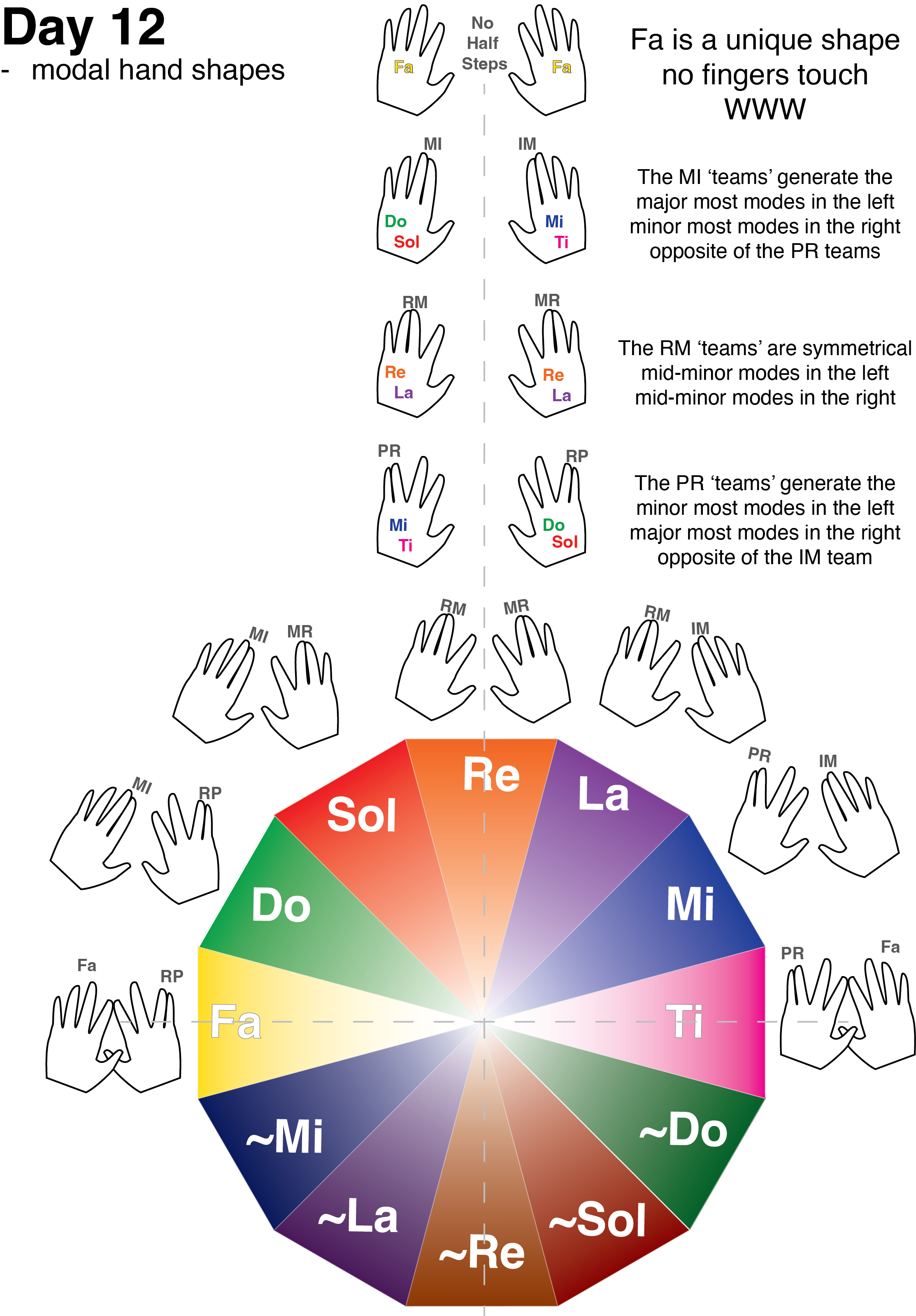
This means that whenever I place 8 fingers on 8 adjacent white keys, The right hand won’t just form a different shape from the left, it will form the tonal shape of the DOMINANT of whatever shape the left hand is making - indexed, for now, by its pinky (lowest note). This means not 7 unique tonal hand formations, but 4.
Where H = Half step & W = Whole step we have for any single hand the following tonal formations:
Ti & Mi formation = HWW
La & Re formation = WHW (the symmetrical formation)
Sol & Do = WWH
Anticipating both the topography & the tonality of any 8 adjacent white key now boils down to knowing its left hand (root) & right hand (dominant) formation.
I practice lifting my hands off the keyboard & moving to the left, but not by step, by resolving down by successive 4ths. I notice that when making this type of jump the Left hand takes on the shape of whatever the right had been holding previously. The right must shift it’s half step according to whatever the new ‘dominant’ position predictably requires. The sequence goes something like:
0. Starting at center
Left_Ti : Right_Fa
(shift down a 4th)
Left_Fa : Right_Do
(shift down a 4th)
Left_Do : Right_Sol
(shift down a 4th)
Left_Sol : Right_Re
(shift down a 4th)
Left_Re : Right_La (symmetry, half steps are IR in both hands)
(shift down a 4th)
Left_La : Right_Mi
(shift down a 4th)
Left_Mi : Right_Ti
(shift down a 4th)
Left_Ti : Right_Fa
This completes the cycle just as the shape reaches the lowest possible BC (Pacific Ocean). Left Pinky pets the side of the Orca fin.
Reversing this order steps the hands back to center,
& continuing another 7 half ocatves takes the continuous tonal shape up to where the right pinky can play the highest possible BC (Ti/Do): The North Pole.
If this is hard to follow in text, I will make a simple diagram showing these shapes. This exercise turns each half mode into a finger game of which two fingers are touching. It allows the hands, as they fall down on the key surface to know precisely where to expect find its one ocean. For keys & modes beyond those of the hard coded C major family this can be abstracted into the hands & ‘oceans’ (tonal half steps, can be projected onto any assortment of black & white keys needed to match a custom key center.
I practice moving my 8 tone shape through all 7 modes of the C major set. As i place my hands down anywhere on the key surface, I anticipate the location of the ocean for each hand, & then feel silently as contact with the black keys confirms my expectation once hands are lowered into place. I do stepwise shifts, & mediant shifts in addition to 4ths. The navigation method feeling more reliable & more light weight with each successful shift.
End of Practice.