Day 12.2 : Post Practice
While taking the dog for a long walk this afternoon I thought about the modal hand shapes.
Practice Begins.
What this really feels like is playing violin. Or at least the way I learned to play the violin. Years ago, through similar pre-dawn, immersive practice sessions, I found that tonal patterns existed in the hand first, could be audiated away from the instrument entirely & eventually applied to the string. The term half step never made sense to me on guitar, on the violin, the strings are proportionate to the hand - a half step feels like a half step. Also the similar structural inheritance of modes around the circle of fifths is easy to observe on the violin. The instrument is tuned in 5th, so modes such as Do can be played by reusing the same 4 tone shape across two adjacent strings.
None of the mappings from directly map onto the piano. It is only the left hand that control tonality on the strings & even there the hand is inverted relative to how the left naturally falls on the piano. Adding the right however makes modal patterns even more clear as each entire 8 tone modal can be modeled within a single two-hand pose.
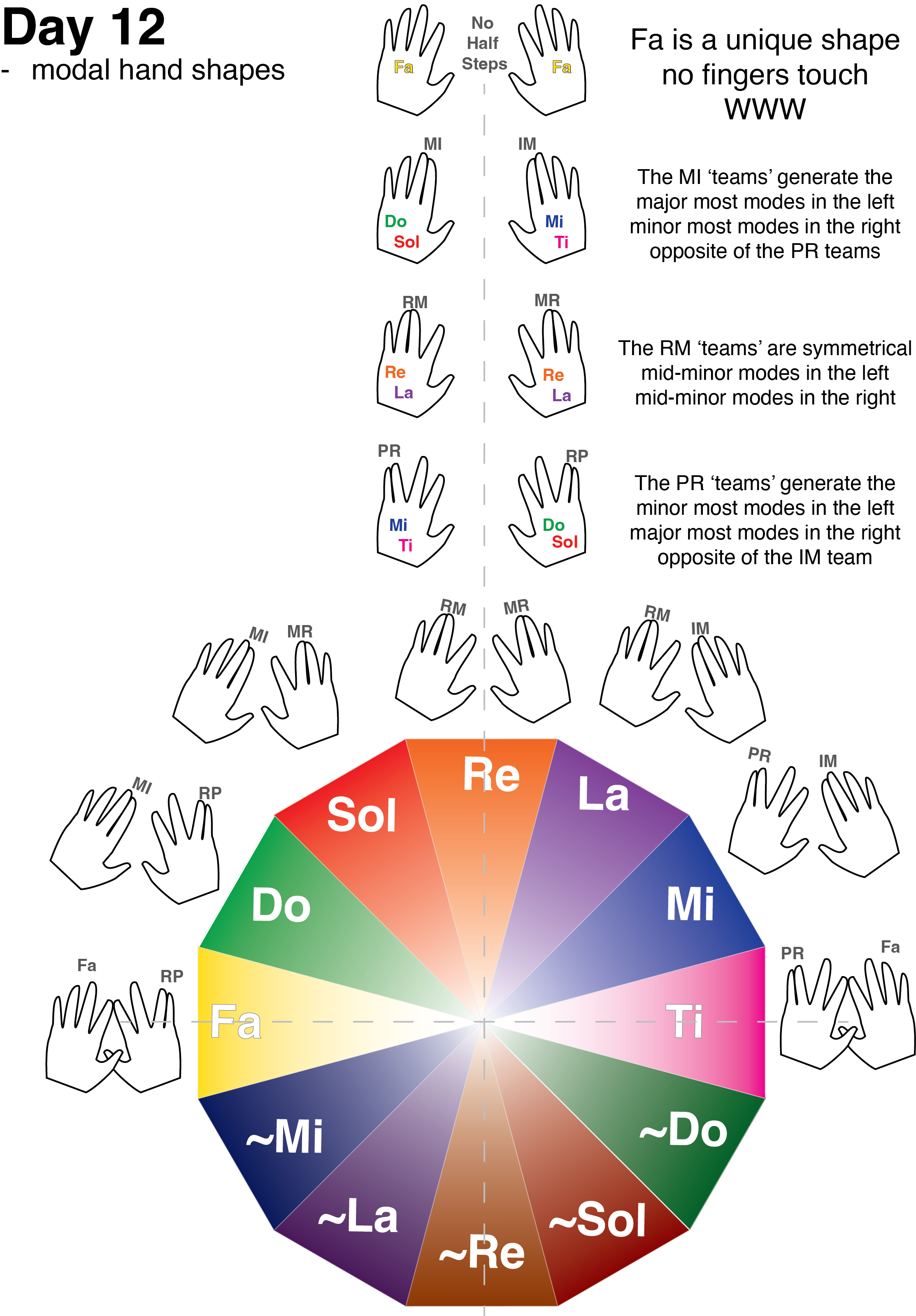
Thinking about the modal hand shapes on piano further, their construction just gets simpler & simpler. Basically the question is, in each hand, is the half step among the first two keys (IM), middles two keys (MR), last two keys (RP), or not at all (Fa). This observation further serves to demonstrate Fa’s special generative place in the solfege, Re once again as the symmetrical center of tonality. This exercise also serves to show that what are commonly referred to as “major” & “minor” modes are part of a consonance/dissonance continuum that stretches from Fa to Ti across the circle of 5ths. The hand shapes discovered today allow anyone to not only demonstrate this at the piano, but embody these modal structures in a way that can be completely separate from any instrument.
When I got home I updated the diagrams for day 12 (see attached).
End of day 13.