Day 1 : Finding Center
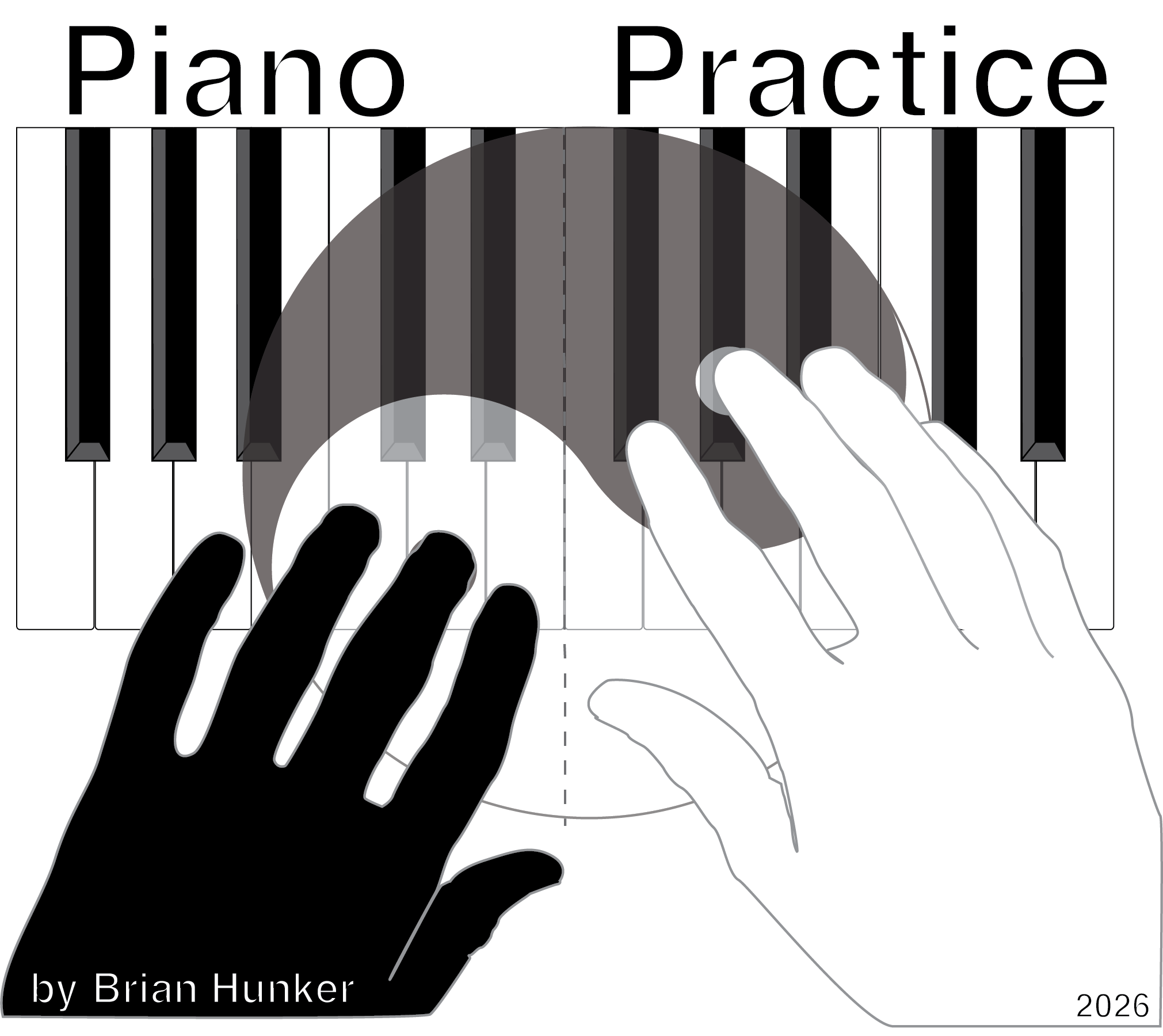
Piano Practice : Book Cover Image, 2026 edition
DAY 1
We begin by discovering the Center.
Exercise 1
Finding & Exploring the Center of the Keyboard
Sit at the approximate center of your keyboard.
Reach out & place both hands on the surface as gently as you can. Take a few deep breaths.
Try to take stock of what muscles are working in your body to hold you in this posture.
CHECK IN WITH THE LOWER BODY
Piano Practice · 1
QUESTIONS:
Are your feet & legs at rest?
– If not, can you adjust their position to one where they can rest?
Are your legs & feet awake?
– Can you feel whatever's going on at the ground under your feet?
How straight & centered do your hips feel?
– Are there any adjustments you'd like to make here?
Is your lower back serving to lift your body? Perhaps tilting you slightly forward, toward the keyboard?
CHECK IN WITH YOUR CORE
QUESTIONS:
Are you breathing from your diaphragm?
– If not, can you start doing that now?
Are the muscles of your core poised & ready to oppose one another to assist diaphragmatic breathing?
CHECK IN WITH YOUR UPPER BODY
QUESTIONS:
Are your upper back, shoulders, & neck comfortably relaxed? Can you feel your heart pulsing in your ribcage?
How far are your arms extended?
How heavy do your arms feel?
Can you feel the chest & shoulder muscles (even the front abdominals) working to keep the hands suspended above the keyboard?
Would changing the height or placement (left/right, front/back) of your seating allow you to reach the keys with less effort?
CHECK IN WITH YOUR HEAD
Without disturbing the rest of your body, in time with the gentle slowness of fully comfortable in & out breaths, turn your head from one side to the other.
Bring your head back to center.
Take two breaths.
On a slow inhale, tilt your head up / back.
On a slow exhale, tilt your head forward / down.
Can you detect the location of the muscles needed to do this?
CHECK IN WITH YOUR FACE
On exhale, squeeze the muscles of your face together, like you've just tasted something bitter.
On inhale, relax your face as completely as you can. Toward the end of the exhale, open your face:
– Pull your ears back, raise your eyebrows, slowly lower your jaw & widen your mouth.
CHECK IN WITH YOUR HANDS
QUESTIONS:
Are they still resting on the keyboard after all that? How far apart do they feel?
Can you gently bring them together, without disturbing your posture — perhaps by simply allowing the forearms to rotate towards the center?
Are your hands now in the position shown in the chart (more or less)?
Congratulations! You have discovered the exact center of the piano.
CHECK IN WITH THE HANDS & FINGERS
For this it is best to close your eyes.
Close your eyes & just allow your fingers to explore the space for several long, slow breaths. Try not to create any sounds. Deprived of both sight & sound, your awareness can most fully observe the many sensations coming from your fingers.
QUESTIONS:
What did your fingers tell you?
Is one hand more sensitive than the other?
What happens if you leave one hand idle while searching with the other?
Exercise 2
The First Tonal Sound
Okay, if you are reading this then your eyes have re-opened. I'll tell you just a few things about what I observed here at the center of the piano.
The piano key surface is not flat.
– Some keys are raised up — the black keys.
– Other keys are lower by comparison — the white keys.
In my right hand, the three fingers in the middle line up with three black keys.
– At center, my right hand starts off in the UP position:
– middle finger trained on the middle of the black keys.
In my left hand, the three fingers in the middle line up with three white keys.
– At center, my left hand starts off in the DOWN position: – middle finger trained on the middle of the white keys.
PLAY the notes under each middle finger.
– Pretend for a moment that these two tones are the only two tones the instrument can make.
– Experiment. Create sound patterns with this two-tone sequence.
– Repeat playing both middle fingers simultaneously as a two-tone CHORD.
– Create rhythmic patterns with this chord.
This central sound is called the TRITONE.
All the TONAL RELATIONSHIPS that we hear — all of MELODY & HARMONY, what we call our sense of TONALITY — comes from this central relationship.
The sound of the Tritone is perhaps most fully described as PERFECT DISSONANCE.
– As we will see, every other key, every other tonal sound, we localize as closer to one or the other of these two rather perfect extreme poles.
PLAY around with these two central fingers on the two central tones of the piano.
QUESTIONS:
Are you able to create different dynamic levels?
– What does it sound like when played softly? – What does it sound like when played loud?
What happens when you try to connect sounding these tones to the cycle of your diaphragmatic breath?
– Can you mark the inhale with 4 equally spaced tones? – Can you mark the exhale with 4 equally spaced tones?
Exercise 3
The First Tonal Scale
Let's do one more thing today.
Consider that each middle finger is flanked by an index & a ring finger.
Consider that these 3 fingers are longer, & more similarly situated on the hand.
Consider how these 3 fingers can work most effectively as a group that does not include the thumb & pinky.
Notice how, at center position, the left hand 3-finger group lines up with 3 DOWN (white) keys.
Notice how, at center position, the right hand 3-finger group lines up with 3 UP (black) keys.
Notice how, at center position, combining the three DOWN (white) keys of the left with the three UP (black) keys of the right, the two hands form a contiguous scale.
Each step of this scale is exactly one WHOLE TONE away from every other step. We call this scale, & the conspicuously emotional sound it makes:
the WHOLE TONE SCALE.
Keeping each finger on the surface of its UP or DOWN key — see if you can play around with the whole tone scale.
QUESTIONS:
Can you roll the consecutive scale steps smoothly up or down?
What happens when you play more than one of these tones at the same time?
What does it feel like physically to play all six tones at once?
What does it feel like to alternately play all the left hand notes & then all the right hand notes?
Are there any obvious mix/match patterns you can feel between this set of tones?
When your 3 central fingers are active, what are your outer fingers feeling (the pinky & the thumb)? Are they relaxed? Can you get them to relax even while the other 3 repeatedly strike notes?
What else do you notice?
Spend a few minutes recording your answers to the questions (in the space provided next to each question), & write below any other additional thoughts that you realized today. Even if you never come back to read what you write here, simply taking a few minutes to put your experience into words will help solidify what you have learned & prepare you for what you will learn tomorrow.
— Practice Ends —