Day 14 : Place to Be
DAY 14 : Place to Be
Today I wake up a little before six. I let Oreo in & feed him before making the coffee, trying to free my mind of expectations for today’s practice. Feeling both tired & still determined.
I find the Vose bench right where i left it. I wish I hadn’t because it means Remi didn’t touch the piano yesterday. Though now that I think about it, I’m remembering that Taylor got him a little electronic play-school “DJ setup”. He’s always experimenting, & likes to have stuff to fiddle around with whenever he’s strapped into his carseat. The device has a turntable you can scratch, some preprogrammed electronic music which is honestly pretty good. The variance of rhythms across the little demo songs struck me as really good for him to have not just exposure but his own access to; starting & stopping as he chooses. I’ve seen him play with this toy & I know he’s listening to it because after he presses play on one of them, he often bops along mirroring the energy of beat.
The toy also has along the bottom a two octave keyboard which, now that I think about it, is perfectly downsized for his tiny hands.
Taylor mentioned it again just last night saying while they were on a drive, she was surprised to find out how well he could pick out individual tones on the keyboard. She said when she first heard him doing it, she thought it was her mother who was riding in the back seat next to him. I told her how I’d seen him do it too on the Vose. He’s gone from banging the keys with his palms like a bongo drum (honestly not a bad technique imo) to resting both his hands on the key surface & activating mostly the raised black keys with his index fingers, sometimes index & middle. He does these in very short bursts, a minute or two, & then he wants to move on. But during that time his ability to focus, the way he fiddles around, nudging information out of nothing, in order to create his universe.
Behind the Vose I put my wireless headphones on & decide to try something I used to do all the time back in the guitar learning days.
A robotic voice assures me that bluetooth pairing attempts have been a success.
I open up Spotify on my phone having two songs on my mind, both by the band Radiohead:
“Everything in It’s Right Place”?
or
“How to Disappear Completely”.
Time to decide,
but I can’t.
I take a breath, flip a coin, & close my eyes.
Practice begins.
Exhaling I celebrate catching the opening pulse with both hands & both feet. I stay on the beat & immediately try to minimize movement around center. C’mon… act like you have been here before (you haven’t).
It’s the start of your favorite song in base 10. The relentless electronic keyboard pattern is softer than you anticipated, that was the main reason you wanted the other one first, for its assured softness.
I try to allow the dynamic of the pulses to transfer directly to my shoulders, arms, fingers, & toes pulsing together with the sounds coming in from the headphones; trying to impose nothing & merely experience an reflected interpretation.
There are no drum fills or crashes or breaks in the marching along of this song, though there is a sort of breakdown in the middle, right where one belongs. It is the escalator that slowly lifts you up into Kid A.
The lack of crashes helps to obscure its odd meter.
The most natural way to breathe along to this song is 5 pulses in (pentatonic), & 5 pulses out (anti~pentatonic).
The other main feature of this song is there is a part in the middle where, without missing a beat, the song mysteriously flips its phase. It’s a truly mysterious moment that anyone who tries to play along to this recording (which is perhaps the truest form of active listening) will experience. In this moment where, at the beat that is the precise climax of the buildup, when Thom Yorke sings the highest vocal line “What was that you tried to SAY…..?” The beat goes on without juking or jumping a step, but the song feels like the rhythm is going backward. The confusion passes as this cycle repeats. You eventually settle in & breathe the other way, because that is what the song is now doing.
Staying inside through this part of the song requires knowing that this great divide is there, & having a plan for what to do when it arrives. What I do is two exhales in a row, on either side of the climactic turning point. To me this represents a flip from the choice made at the first pulse, to breathe in first. This choice, to begin not with action but with anticipation; this is the edit mode. In this mode the resulting exhale|action becomes an attempt to successfully mirror the detailed anticipatory thoughts of action.
I spend the first half locked into the 5 + 5 meter of “Everything in Its Right Place”, alternating the following along the two phases of breath:
INHALARE : FEET RELAXARE (pedals up), ARMS RELAXARE (hands|arms come in to center), body rocks back, head tilts up as air fills the lungs to a point of being full without hyper extension.
This is where the 5 counts really workout something kind of amazing: I spent 3 beats on the inhale & then the last two kind of suspended. Hovering. Listening to the sound. My shoulders lifted, arms out to the point that the back muscles engage. Shoulder blades touching. Hands held all the way out sending back confirming contact with the highest & lowest edges of the key surface. I mark one beat of deceleration. One beat of drift back toward center. Then on what would be the 3rd of this second group of 3, I commit action.
EXHALARE : Forehead tips & continues forward. Core muscles stop rocking back & slowly begin rocking forward. Sides of both FEET stabilize the forward rocking motion. Muscles that feel like they are under the arch of the foot flex the big toes against the Left & right pedals depressing both. The rocking makes it feel like body weight is going forward into the pedals. Slightly trailing the breath & forward rocking, the shoulders pass the angular weight of the hands/arms to the chest muscles. The shoulder blades separate as the hands move toward center. The fingers & thumbs are slightly limp. Different wrist orientations set up the left & right probes to give back different info. Sometimes dragging finger pads, backside fingernails, one finger at a time, two fingers high, two fingers low, different combinations. I’ll keep one combination for a few breaths, confirm the feeling in rhythm & then change to sample another configuration.
The first 3/5 pulses of exhale are spent bringing the hands together at the Mi|Fa seam in the middle Atlantic, where indexes & pinkies reunite into the heart-shaped box. Then in the 2 remaining beats, as the rocking reaches it forward limit & stops, the hands go forward & the fingers sort Ti|Fa positions among the black keys. I trace the line up to where the fall board used to be. I listen. Listen. & then the feet/core/diaphragm begin the inhale rock-backwards.
A shorter way to say all this is that I have fully become the bird. Though I am sitting, every muscle of which I have voluntary control is comfortably engaged either inducing or governing in opposition each phase of the movement cycle.
I check in with the rhythm to make sure i am reflecting the timing. I am. I can change the threshold between each phase’s acceleration/deceleration threshold from 3:2 to 2:3 (gradual), even 1:4 & 4:1 (more concentrated action). We are getting close to the turning point.
“tired to saaaaay…. tried to saaaaay…… TRIED to saaaaaaayyy…… tired TO SAAAAAAYYYYYY”.
IN-hale-IN-hale-IN | EX-hale-EX-hale-EX || EX-hale-EX-HALE-EX | IN-hale—IN-hale-IN |….
There’s a climactic moment similar to this in the first movement of Beethovens’s 6th symphony.
I begin to wind down the energy, but keeping the same pace. The hands move weightlessly over the key surface.
The song ends, & after a moment of silence is followed by “How to Disappear Completely.” Though I have never been exactly here before Spotify was able to guess what I wanted to hear at this moment most precisely.
I continue the exercise at the slower pace of “How to Disappear Completely”. The meter here is more regular: 3’s & 6’s. Clicking into it means having to give up my 1-2 pulse hovering space. Which I now no longer really need. Each phase now assumes anticipation of switching toward the end. I think of how competitive swimmers change directions underwater; their underwater movements both highly developed & fluently natural.
I make numerous variations to the exercise, each more illuminating than the last. How am I going to be able to remember to document all this? You’re not. Why even think of documentation at a moment like this? You don’t have to. If these variation are important they’ll show up again. Tomorrow. Next week. If they are very important they’ll never stop showing up no matter what you do. The best you can do is construct a narrative, that will surely catch most of this. The better the narrative, the longer you’ll be able to hold all this without having to write it down.
I think about the similarities between this song & “I Though You Were Gone”.
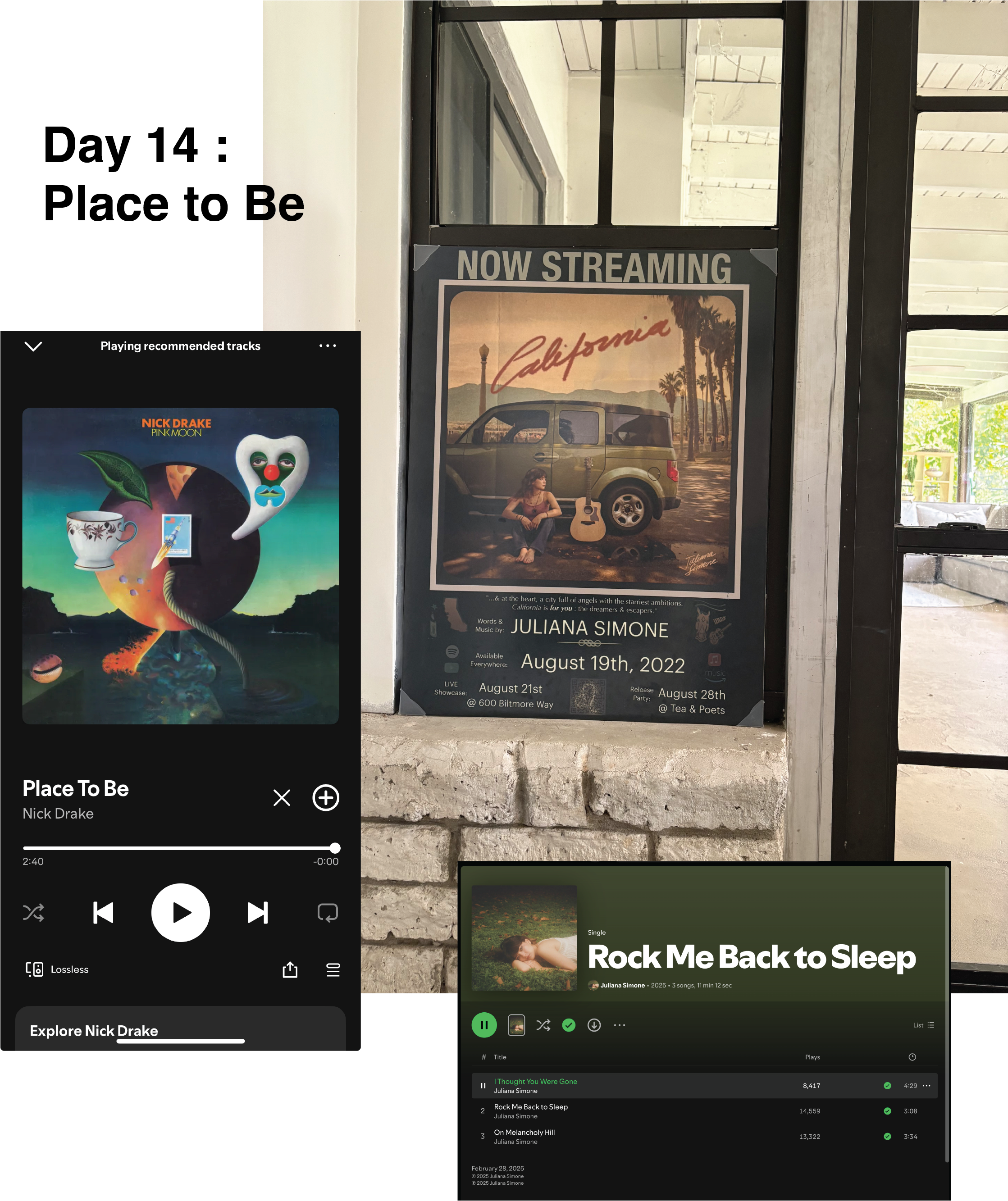
“I Thought You Were Gone” is a much lesser known song written by Juliana Simone. The song is among the first songs ever written by Juliana, it was the first one she sent me & is the reason the Vose is here. Juliana writes & performs her songs solo, accompanying herself on acoustic guitar. But during the pandemic, she contacted me, her one-time guitar teacher, over zoom. She told me that she had recently written a few songs, & asked if I could listen to them & give her some thoughts on how to develop them.
Now that I think of it, the first time I heard “I Thought You Were Gone” was when she played it for me live over zoom. My analytical brain heard the similarities to “How To Disappear Completely” in the guitar strumming. Wanting to be a helpful as possible, I started to tell her about sus-chords, dynamics, I referenced the guitar work on “Needle In the Hay”. & then I kind of stopped in my tracks. I asked Juliana to please just play the song again for me; having just realized just how truly great her song was. When she finished the second fully-realized performance of the song, I asked if she would please disregard everything I just said. Trying not to be to effusive, I tried my best to let her know that, having had a chance to follow the lyrics & the arc completely from start to finish, I considered the song to be about as good as anything I’ve ever heard in modern song writing. I have heard a lot of amateur songwriters, I know how to be supportive. This moment was due. It was only a matter of time before I ran across somebody who really knew how to write, sing & perform at this level.
I asked if she would send me a voice note of the song so I could listen to it & maybe think of some suggestions for her, after the shock of how good it is wear off. Later that day she sent me a perfect garage band recoding of the song. Complete with space-bar click after the last chord (Bm) dies out. She also sent two or three other songs she had. Each unique, intuitively paced, arc’d, choregraphable, worth every second of its run time. Each sung & strummed in fullest character & with no mistakes.
I was living (with only Oreo) in an ocean of solitude at that time. I listened to the recordings throughout the afternoon. My friend Gabor, who knew how isolated I could become, called & asked if I wanted to meet him for a drink. As we usually did once a week & as I normally I would be happy to do, but this time I remember telling him that I had something I needed to take care of. I remember thinking that I had something i needed to build. That night I added Casio, bass, drums, synth violin/cello & a 12 string guitar to Juliana’s recording of “I Thought You Were Gone.” I did not yet have the Vose. I Mixed down the track with added instruments & sent it back to her.
She listened to it & wrote me back saying that she loved it & asked if I could help her produce a properly recorded version of the song with my arranged instrumentation. She said she had worked with a few record producers in the past & that they didn’t really understand what she wanted to do. Juliana, who was at that time working as a television actor while attending UCLA, said she really wanted to get her music out there. She wanted to see if it could find an audience. I told her that I definitely thought her work had inherent value that would probably appeal to anyone who really listened to it. I told her that I didn’t know how to find an audience, but that I did feel confident that I could arrange & produce something that amplified her writing & the character of her singing voice; something she’d be proud of. I think it was the sound of that 12 string that got me the job.
This marked the beginning of our collaboration which is now 5 years running. To date we have developed, produced & released about a dozen of Juliana’s original songs, 3 Eps, a few covers. I’ve never charged Juliana for anything (other than guitar lessons back in the day). We did have one formal meeting early on at a coffee shop (Chocolate Fashion) where Juliana laid out her terms for how we’d split credit. I told her I don’t need credit. She insisted that she keep 100% of the publishing, but that I should have 50% or the performance royalties. I told her that sounded great.
In the run-up to the release of her first digital single (California : April 19th, 2022) Juliana walked me through how to join distrokid & claim my split credit. She also figured out how to join ASCAP & said I should as well. I did. By this time I was unofficially her ‘band’ recording drums, bass, & electric guitar for nearly 20 original songs. We fully collaborated on the production side. I insisted that because the sonic vision was hers, she should consider herself the executive producer, my role was more musician / facilitator engineer. Our collaboration work so well because both Juliana & I maintained a selflessness in service of each song project. To Juliana’s credit, she always came up with great ideas & was never afraid to admit when something wasn’t working.
Juliana envisioned the 12 recorded songs as an eventual sequenced album she called For You - complete with a Side A | Side B structure. Together Over the next 5 years we released almost all the For You songs on separate 3 song EPs. rather like the first ‘album’ by the Beta Band.
“I thought You Were Gone” is For You’s track 2; following her song “Surrender”.
The ‘final’ version of “I Thought You Were Gone” was released Feb 28th, 2025 as track 1 of Juliana’s “Rock Me Back to Sleep” EP. The song is built around her acoustic guitar, my acoustic 12 string, a thick bassline & Juliana’s etherial-then-powerful vocal performance. Chiming electric guitars (my white & gold Epiphone archtop) replaced the original synth (fake sounding) strings & they kick in with teh drums, sort of surprisingly, about half-way through the song (another parallel with “how to disappear”). Halfway through the first verse, before the curtain falls & the song breaks open, there is a dark piano line that develops through to the end. Early in the recording process I knew the Casio just could manage the sound we needed. At the time I lived about a mile up the road from the Steinway Piano Gallery of Coral Gables. I though about going in there & saying to the sales staff that I was looking to buy one. & then surreptitiously record the performance into a hidden recording device. I abandoned this idea when I realized I didn’t even own the right shoes to pull that off.
I remember telling Juliana, I think we are going to need to get a piano in here for this. Then one night, at 3 or 4 in the morning, it hit me. I opened my phone & downloaded an app called Offer-Up. I typed “Miami Piano” into the search & found dozens of piano’s, grands, uprights, all sizes & conditions, available for nothing or next to nothing. People just wanted you to come & take them away. 3 days later the badly out of tuned Vose was in my old house. I bought a set of piano tools for $14, & a manual on piano repair, & started getting to work. When the Vose first drops in half way through the second verse, it makes me extremely proud every time I hear it. It’s exactly the sound/affect I heard internally two years before producing it.
As I continue to breathe, & move my ‘wings’ across the smoothly scrubbed surface of Vose, arms, breath, pedal, head, rocking in sync with “How to Disappear Completely” I realized how tired I had become. Not physically. My heart felt tired.
I remember thinking, if Spotify chooses to play “I Thought You Were Gone” next I’m going to die. That didn’t happen. Probably because “I Thought You Were Gone” isn’t well known enough. Our dozen songs get a few thousand unique listeners a month on Spotify. The listenership increases steadily whenever we release something new.
To day I didn’t get Juliana Simone. I got Nick Drake instead.
I stop flapping my arms & bring my ten fingers home to the central two Black pentatonic sets. Feeling 2:3 in each hand. I continue breathing & rocking in time as I slowly trace the long surface of the ten black keys. Feels a bit like raising 10 faders at once on a mixing console. Like Coldplay’s producer who, in his master class (which I took in order to make Juliana’s songs sound as best as we possibly could get them) suggested that mixing, including the raising & lowering of levels was almost realtime performance art. He didn’t say as much but that was my takeaway from what he was saying. I don’t have a mixing console & so I use automated curves - but I try to use them in service of that idea. A bit like being an audio cinematographer who preserves realism but dynamically shapes the cinematic focus.
I don’t really think about anything other than how tired I feel, & keeping the cycle regular with the incoming sound. Definitely going to quit when this song is over.
The song ends &, before the next one randomly begins, I press the stop button on the side of my wireless headphones.
There’s a confirmation beep & then silence.
My eyes open on the lit phone resting on the Vose’s music stand in front of me. The phone displays the cover & title of the last song. Nick Drake’s “Place to Be”.
Practice ends.